Edoo
2025
Improved match quality for a two-sided HR platform

Problem area
A match is only as good as the data behind it
Young job seekers needed to show their specific educational background. Recruiters needed to define exactly who they were looking for. But the platform only offered generic fields that didn't capture real differences. The result was poor matches that pushed users toward competitors or made them use multiple platforms to find what they needed.
Starting point

Her contribution has been key to defining a cohesive, human-centered, and high-quality product vision. She stands out for her commitment and resilience, always maintaining a constructive attitude even during the most demanding moments. Her work is characterized by exceptional attention to detail, a methodical approach, and a strong ability to take on responsibilities beyond her role as a Product Designer, bringing strategic insight into both product and user needs.

Design decision 01
Education as the key differentiator
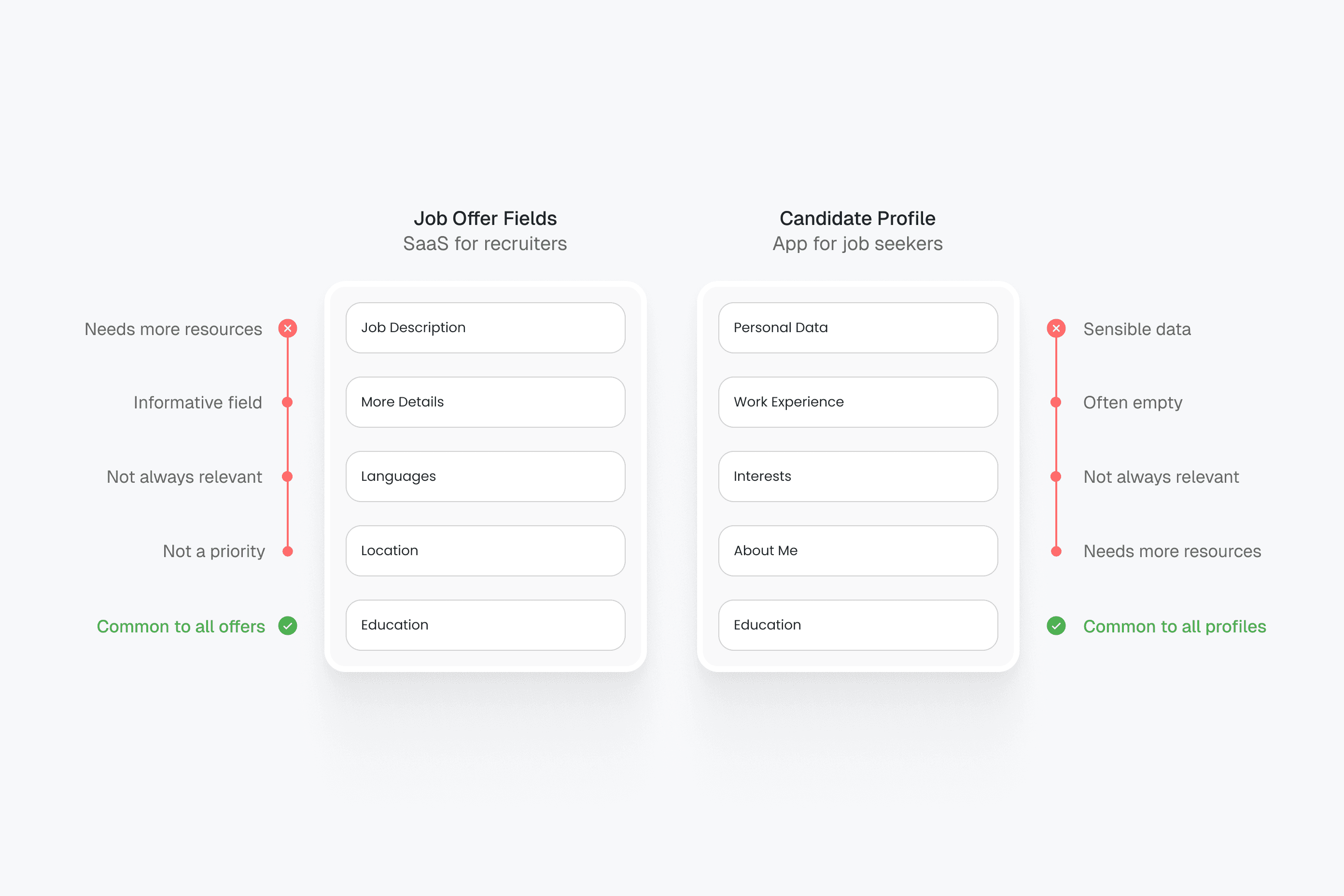
Prior research with candidates and recruiters showed that education was the most reliable field for matching, since experience was often missing for young users and other fields like languages were not a top priority for recruiters. This insight, combined with the fact that competitors in Spain were not offering detailed education matching, led me to prioritize education as a differentiator we could build with limited resources.
Field comparison
Design decision 02
Constraints that shaped smarter decisions
Once I decided to focus on education, we faced a technical limitation: with only one developer available, large database changes were not possible. I researched the Spanish education system to find specific field values that could work within the existing structure. This constraint led me to a solution that improved how recruiters find candidates and how young users find job offers that match their profile, without needing more resources.
Database example

Design decision 03
Guiding users to share enough
With the new fields defined, I needed to design how users would interact with them. Research showed that users filled open fields inconsistently and often with skepticism or low motivation, especially young users, which contributed to poor match quality. I applied progressive disclosure to guide users through specific options, resulting in a form that balanced ease of completion with the specificity needed for better matches.
Before and after
Retrospective
From vague matches to concrete results
I worked with one developer in a fast-paced environment, with no budget for automation or AI features. We had to be strategic about where to make changes without touching the database structure too much. Working on two platforms for two different users at the same time helped me understand how both sides need to work together.
To measure success today, I would look at match quality score, how often users return to the platform, and the rate of matches that lead to hires. With more time and resources, I would have explored ways to automate profile completion for young users, using data from a CV upload or connecting with their LinkedIn account.